
The Partition of India in 1947 divided British India into two new independent dominions, India and Pakistan, ending nearly two centuries of British rule. Pakistan became independent on 14 August 1947, while India marked independence on 15 August. The political transition was celebrated as freedom from colonial rule, but it also triggered one of the largest and most traumatic population movements of the twentieth century. Millions of people crossed the new borders, while communal violence killed hundreds of thousands of people, with estimates varying widely. (“The Indian Independence Act of 1947 provided the legal framework for the creation of India and Pakistan as independent dominions.”)
Partition was not caused by one event or one political leader. It developed through decades of constitutional disputes, competing ideas of nationalism, British colonial policies, disagreements between the Indian National Congress and the Muslim League, and growing communal violence. By 1946–47, attempts to preserve a united India had largely broken down.
To understand 1947, therefore, it is necessary to look beyond the date itself.
What Was the Partition of India in 1947?
The Partition of India was the division of British India into the independent dominions of India and Pakistan. The process involved not only the creation of a new international border but also the division of the provinces of Punjab and Bengal, as well as government institutions, military forces, financial assets, transportation networks, and administrative structures. The legal framework was provided by the Indian Independence Act of 1947, passed by the British Parliament on 18 July 1947.
Pakistan initially consisted of two geographically separated regions: West Pakistan and East Pakistan. East Pakistan later became Bangladesh after the 1971 Bangladesh Liberation War.
Partition also transformed the lives of people who had never considered themselves migrants. A village, farm, shop, or family home could suddenly be located on the “wrong” side of an international border.
That is one reason Partition remains such a powerful memory in South Asia
.The Partition of India in 1947
Why Was India Partitioned in 1947?
There was no single cause. Several political and historical developments came together.
British Colonial Rule and Communal Politics
British India was home to a vast mixture of religious and cultural communities, including Hindus, Muslims, Sikhs, Christians, Buddhists, and others. During colonial rule, political representation increasingly became organized around categories of community and identity.
The British introduced constitutional arrangements that included separate electorates for Muslims, beginning with the Indian Councils Act of 1909. Such policies did not create religious differences from nothing, but they helped institutionalize community-based political representation.
As the demand for self-government grew, the question became increasingly difficult: What would political power look like after the British left?
For Muslims, who were a large minority across British India but a majority in several important regions, fears about permanent political marginalization became an increasingly important issue.
The Open University notes that independence raised particularly difficult questions about the political position of Muslims within a potentially Hindu-majority state.
Congress and the Muslim League
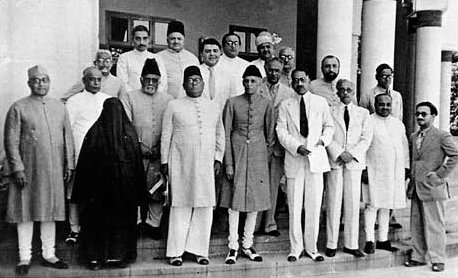
The Indian National Congress became the leading organization in the struggle against British rule, while the All-India Muslim League, founded in 1906, increasingly presented itself as the political representative of Indian Muslims.
Muhammad Ali Jinnah initially supported cooperation between India’s major political communities. Over time, however, he became increasingly convinced that Muslims required strong constitutional safeguards and political autonomy.
The 1937 provincial elections became an important turning point. Congress formed governments in several provinces, while the Muslim League struggled to establish itself as the sole representative of Muslim political interests. The political disagreements that followed contributed to increasing distrust between Congress and the League.
By the 1940s, the question was no longer simply whether India should become independent. It was also what kind of political system would replace British rule.
The Lahore Resolution of 1940
The demand for a separate Muslim homeland became much more prominent after the Lahore Resolution of March 1940.
The resolution called for Muslim-majority areas in the northwestern and eastern zones of India to be grouped into independent political units with autonomous and sovereign constituent regions. It became closely associated with the Pakistan movement.
The idea of Pakistan developed during the following years into a powerful political demand under Jinnah’s leadership.
This is an important point because Partition should not be understood as something suddenly invented in 1947. The political demand for a separate Muslim state had been developing for years before independence.
World War II and the Weakening of Britain
The Second World War changed the political situation dramatically.
Britain emerged from the war economically and politically weakened. Maintaining an enormous colonial empire became increasingly difficult, while Indian political pressure for independence had grown stronger.
The Quit India Movement of 1942 demonstrated the intensity of opposition to British rule. Meanwhile, the Muslim League expanded its political influence during the war years.
By 1945–46, Britain was increasingly committed to transferring power.
The problem was that Congress and the Muslim League still disagreed fundamentally over the political structure of an independent India.The Partition of India in 1947
The Cabinet Mission Plan of 1946
One of the most important attempts to prevent Partition was the Cabinet Mission Plan of 1946.
The British proposed a federal arrangement that would keep India formally united while giving substantial powers to provinces and grouping them into sections.
For a moment, this offered a possible alternative to Partition.
But the arrangement was fragile. Congress and the Muslim League interpreted important parts of the proposal differently, especially regarding the strength of the central government and the future role of provincial groupings.
The agreement eventually collapsed.
This failure matters because it shows that Partition was not necessarily inevitable from the beginning. There were still competing possibilities in 1946. The political space for compromise, however, was rapidly disappearing.
Direct Action Day and the Rise of Violence
On 16 August 1946, the Muslim League observed Direct Action Day to demonstrate support for its political demands. Severe communal violence broke out in Calcutta.
The violence did not remain confined to one city. Communal conflict spread to other parts of the subcontinent, including Bihar, Noakhali, and Punjab.
By early 1947, political disagreements had increasingly become connected with fears about physical survival.
This changed the atmosphere surrounding the negotiations. A constitutional disagreement could be debated in a meeting room. Communal violence created a much more dangerous reality on the ground.
Mountbatten and the Decision to Partition
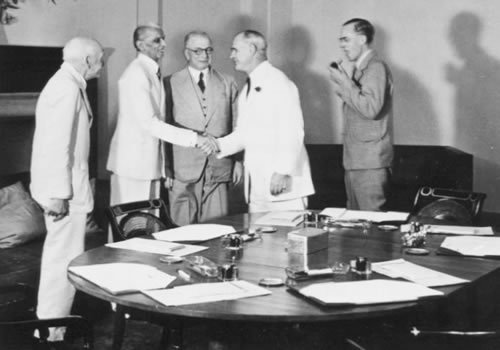
Lord Louis Mountbatten became the last Viceroy of British India in March 1947.
Britain had originally indicated that power would be transferred no later than June 1948. Mountbatten’s government instead accelerated the timetable dramatically.
On 3 June 1947, the British government announced the plan for dividing British India.
The Indian National Congress and the Muslim League accepted Partition as the basis for transferring power.
The decision was formalized through the Indian Independence Act 1947, which established the two new dominions. The Act also provided for the division of Punjab and Bengal.
How Were the Borders Drawn?
This is one of the most frequently asked questions about Partition.
The new boundaries of Punjab and Bengal were determined by boundary commissions chaired by Sir Cyril Radcliffe, a British lawyer who had not previously worked in India.
The task was extraordinarily difficult. Religious communities were not neatly separated into two geographical blocks. Hindus, Muslims, and Sikhs lived in mixed towns and villages, often alongside one another for generations.
The boundary commissions therefore had to divide areas with complicated demographic and administrative realities.
The final boundary awards were announced on 17 August 1947, two days after India’s independence and three days after Pakistan’s independence.
For people living in Punjab and Bengal, this delay had serious consequences. Some communities did not know immediately which country their district or town would belong to.
The border was not simply a line drawn across empty land. It passed through homes, farms, roads, railway systems, businesses, and communities.The Partition of India in 1947
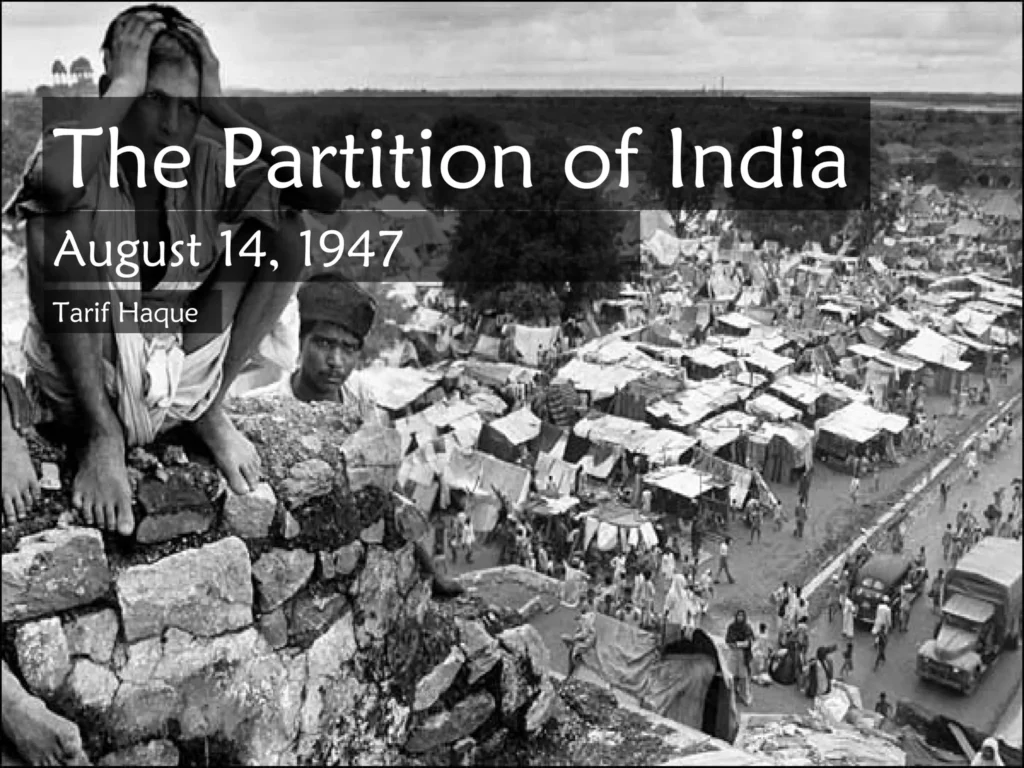
The Great Migration
The human movement caused by Partition was enormous.
Millions of Muslims moved toward Pakistan, while millions of Hindus and Sikhs moved toward India. The exact number varies between sources, with estimates commonly reaching around 15 million or more, depending on the period and population movements included.
Punjab experienced particularly dramatic demographic change. One academic study estimates that approximately 9.2 million people were displaced in Punjab alone.
People traveled by:
- Train
- Truck
- Bullock cart
- Horse
- Boat
- On foot
Some carried possessions. Many carried almost nothing.
A family that had owned land for generations might leave with only clothes, food, documents, and a few personal belongings.
For many refugees, the journey itself became dangerous.
Violence During Partition
The migration occurred alongside widespread communal violence.
Punjab was particularly badly affected. Villages and towns were attacked, homes were destroyed, and trains carrying refugees sometimes became targets of violence.
The number of people killed remains disputed. Estimates range from several hundred thousand to around one or two million, depending on the source and methodology. Stanford’s historical overview gives a range of roughly 500,000 to 2 million deaths, while other scholarly sources provide different estimates.
For that reason, it is better to describe the death toll as disputed rather than presenting a single number as certain.
Women experienced particular forms of violence, including abduction and sexual assault. Families were separated, children became lost, and countless people disappeared during the chaos.
Yet violence was not the entire story.
There were also people who protected neighbors from another community, shared food, provided shelter, or helped strangers escape danger. These stories of courage and compassion are an important part of the historical record too.
The Partition of India in 1947
What Happened to Refugees After Partition?
Independence did not mean the crisis ended.
Millions of refugees needed:
- Housing
- Food
- Employment
- Medical treatment
- Education
- Land
- Legal documentation
Cities such as Delhi, Lahore, Karachi, and Amritsar underwent major demographic changes.
Refugees gradually rebuilt their lives, established businesses, entered new professions, and formed new communities.
Some families prospered again. Others remained economically and psychologically affected for decades.
The effects were particularly significant because the people who crossed the borders were not simply anonymous populations. They included farmers, teachers, shopkeepers, traders, civil servants, craftsmen, students, and professionals.
Partition therefore reshaped entire economies and urban societies.
The Partition of India in 1947
The Impact on Punjab and Bengal
Punjab and Bengal were at the center of Partition because both provinces contained large Muslim and non-Muslim populations.
Punjab was divided between India and Pakistan. Its division produced some of the most intense violence and migration.
Bengal was also divided. West Bengal became part of India, while East Bengal became part of Pakistan, later becoming Bangladesh in 1971.
The two regions demonstrate why Partition cannot be reduced to a simple division between two religiously homogeneous territories.
In many places, religious communities were deeply interconnected economically and socially.
The new borders disrupted those relationships almost overnight.
What Were the Long-Term Consequences?
Partition did not end with independence.
One of its most important long-term consequences was the deterioration of relations between India and Pakistan.
The dispute over Jammu and Kashmir became an immediate source of conflict and contributed to the first India-Pakistan war beginning in 1947.
The two countries later fought additional wars and developed a prolonged rivalry.
Partition also influenced:
- National identities
- Military policy
- Foreign relations
- Refugee politics
- Communal relations
- Border security
- Economic policy
- Cultural memory
The division also had consequences far beyond the two new states. When East Pakistan became Bangladesh in 1971, the political map created by Partition changed again.
Was Partition Inevitable?
This remains one of the most debated questions among historians.
There is no simple answer.
Some historians emphasize British colonial policies and the institutionalization of communal political categories. Others focus on the competing political strategies of Congress and the Muslim League. Some emphasize Jinnah’s political objectives, while others highlight Congress’s position on a strong central government or the British government’s increasingly urgent desire to leave India.
The failure of the Cabinet Mission Plan is particularly important because it demonstrates that alternatives to Partition still existed in 1946.
At the same time, by 1947 the combination of political deadlock, communal violence, administrative breakdown, and British impatience made a united settlement increasingly difficult.
So rather than saying Partition was either completely inevitable or entirely avoidable, it is more accurate to say that different political outcomes remained possible for years, but the choices and crises of 1946–47 made Partition increasingly likely.
Why Does the Partition of India Still Matter?
The Partition of India in 1947 is not simply a historical event that ended in August 1947.
Its consequences remain visible today.
Families across India, Pakistan, Bangladesh, the United Kingdom, North America, and elsewhere still preserve memories of villages, cities, relatives, and journeys connected to Partition.
The event also continues to influence how India and Pakistan understand themselves and each other.
Perhaps the most important lesson is that political borders can be created much faster than human communities can adapt to them.
A government can announce a new country in a matter of days. A family may need decades to recover from losing its home.
That distinction is central to understanding Partition.
Frequently Asked Questions
What was the Partition of India in 1947?
The Partition of India was the division of British India into the two independent dominions of India and Pakistan in 1947. Punjab and Bengal were also divided, while millions of people crossed the new borders amid widespread violence and displacement.
Why was India divided into India and Pakistan?
Partition resulted from several factors, including competing political visions, Muslim demands for political safeguards and eventually a separate homeland, Congress-League disagreements, British colonial policies, communal tensions, and the failure of constitutional negotiations in 1946–47. No single cause explains the division.
Who was responsible for the Partition of India?
Responsibility is heavily debated among historians. British policies, Congress and Muslim League political strategies, communal organizations, and the wider circumstances of decolonization all played roles. It is historically misleading to attribute Partition entirely to one person or one community.
How many people died during Partition?
The exact number is unknown. Scholarly estimates vary considerably, from several hundred thousand to around one or two million deaths. The uncertainty reflects incomplete records and the enormous geographical scale of the violence.
How many people migrated during Partition?
Estimates vary, but roughly 15 million people are commonly cited as having moved or been displaced. Some sources give broader ranges, including approximately 10–18 million. The movement continued beyond the immediate independence period.
Who drew the boundary between India and Pakistan?
The Punjab and Bengal boundaries were determined by boundary commissions chaired by Sir Cyril Radcliffe. The final awards were announced on 17 August 1947, after Pakistan and India had already become independent.
Did everyone have to leave their homes during Partition?
No. There was no general legal requirement that every person belonging to a particular religion had to migrate. However, violence, fear, uncertainty, and the creation of new borders caused millions of people to leave their homes voluntarily or under extreme pressure.
What happened to East Pakistan?
East Pakistan remained part of Pakistan after 1947 but was geographically separated from West Pakistan. Political, economic, and linguistic conflicts eventually contributed to the Bangladesh Liberation War, and East Pakistan became the independent country of Bangladesh in 1971.
