
Sunscreen is one of the most important steps in a daily skincare routine, but simply putting some sunscreen on your face is not enough. How you apply sunscreen, how much you use, and when you reapply it can all affect how well it protects your skin.
Dermatologists generally recommend using a broad-spectrum, water-resistant sunscreen with SPF 30 or higher. It should be applied generously to exposed skin before going outdoors and reapplied regularly when you remain outside. (How to Apply Sunscreen Correctly:)
Whether you are going to work, walking outside, exercising, traveling, or spending the day at the beach, learning how to apply sunscreen correctly can help protect your skin from UV radiation, sunburn, premature skin aging, and skin cancer.
What Is the Correct Way to Apply Sunscreen?
The correct way to apply sunscreen is to:
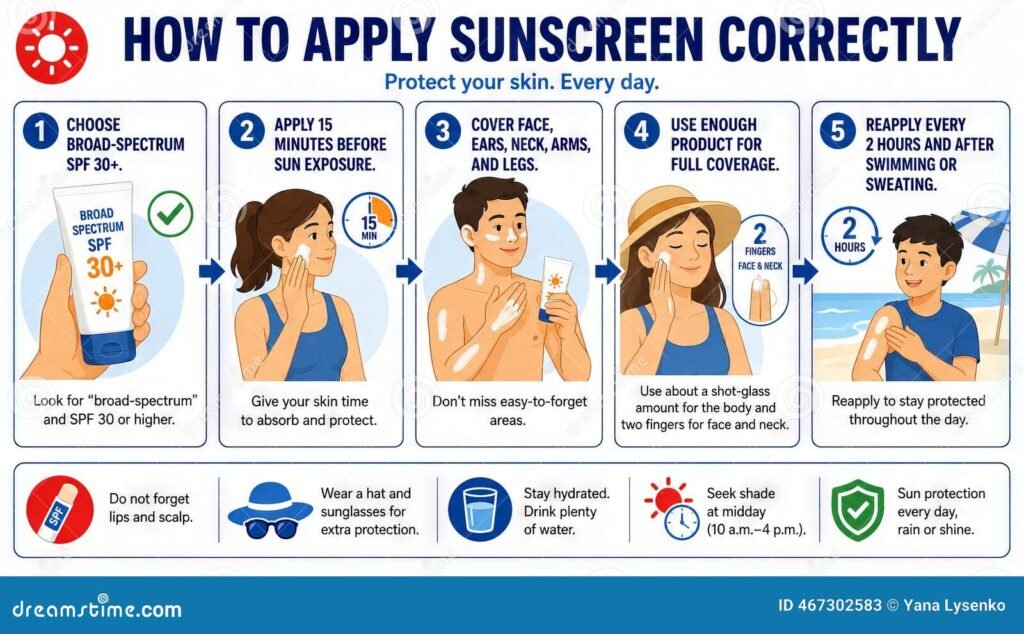
- Choose broad-spectrum SPF 30 or higher.
- Apply it to dry skin about 15 minutes before going outside.
- Use enough sunscreen to adequately cover exposed skin.
- Cover often-missed areas such as the ears, neck, hands, and hairline.
- Reapply approximately every two hours while outdoors.
- Reapply after swimming, sweating, or towel drying.
- Combine sunscreen with shade, protective clothing, a hat, and sunglasses.
These steps follow guidance from the American Academy of Dermatology (AAD) and the U.S. Food and Drug Administration (FDA). (American Academy of Dermatology)
Why Is Proper Sunscreen Application Important?
Sunscreen only works as intended when it is used correctly.
One of the most common mistakes is applying too little. The AAD reports that many people use only a fraction of the amount needed to achieve the protection shown on the sunscreen label. (How to Apply Sunscreen Correctly:)
Another common mistake is forgetting to reapply.
Sunscreen gradually wears away because of sun exposure, sweating, swimming, rubbing, and normal daily activities. This is why applying sunscreen once in the morning may not be enough if you spend several hours outdoors.
Proper application helps create more even coverage and reduces areas of exposed skin.
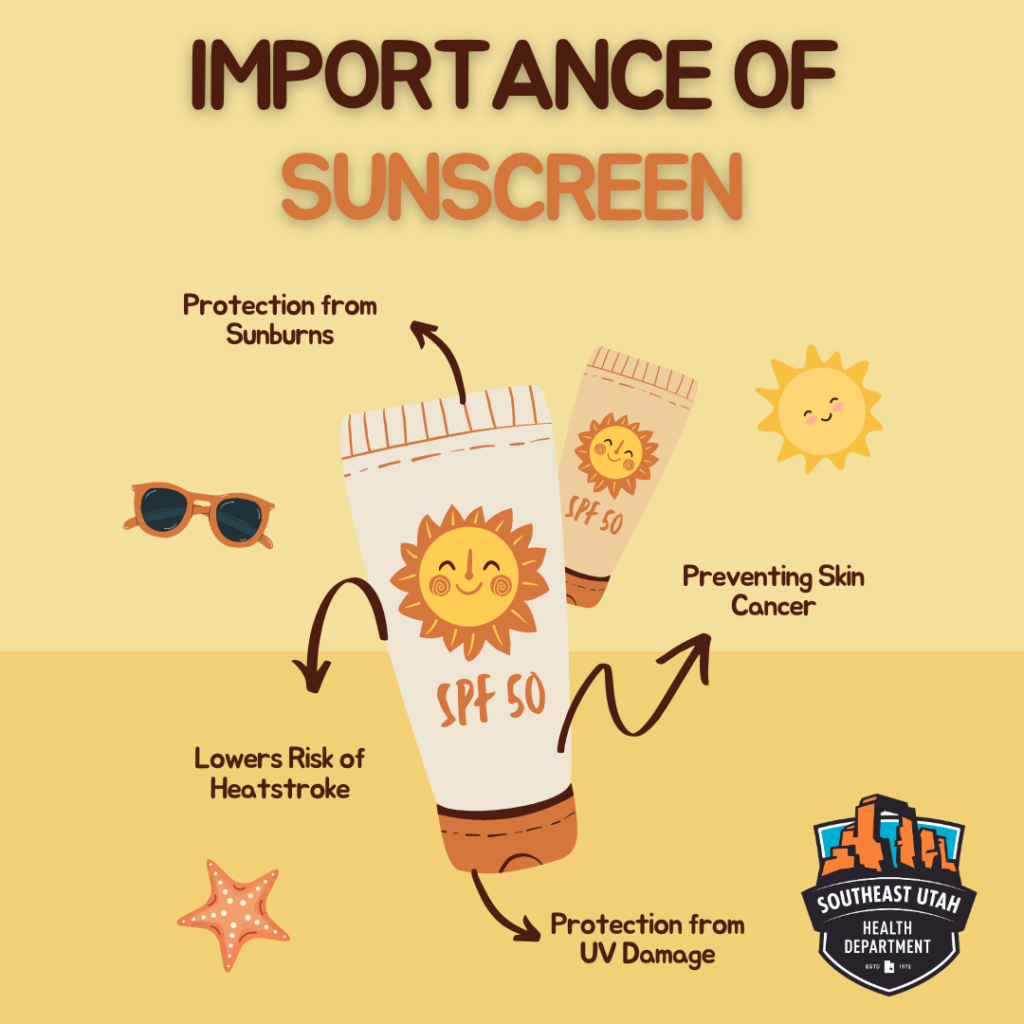
Step 1: Choose the Right Sunscreen
Before learning how to apply sunscreen, choose a product that provides appropriate protection.
For everyday outdoor use, dermatologists recommend looking for these three features:
- SPF 30 or higher
- Broad-spectrum protection
- Water resistance
Broad-spectrum sunscreen protects against both UVA and UVB radiation. UVA exposure contributes to premature skin aging, while UVB is a major cause of sunburn. Both types of UV radiation can contribute to skin cancer. (American Academy of Dermatology)
What SPF Should You Use?
SPF 30 is a common minimum recommendation for everyday protection.
Higher SPF products provide somewhat greater protection against UVB, but they do not eliminate the need for proper application or reapplication.
If you spend extended periods outdoors, SPF 50 may be a practical choice.
The most important thing is to choose a sunscreen that provides adequate protection and that you can comfortably use consistently.
Step 2: Apply Sunscreen Before Going Outside
One of the most important sunscreen rules is timing.
Apply sunscreen approximately 15 minutes before going outdoors. This gives the product time to form a protective layer before you are exposed to sunlight. (American Academy of Dermatology)
Don’t wait until you are already outside to apply it.
For example, if you know you are leaving home at 8:00 a.m., try to apply your sunscreen around 7:45 a.m.
This is especially useful when you are going to spend significant time outdoors.
Step 3: Use Enough Sunscreen
Using too little sunscreen is one of the biggest reasons people may not receive the protection indicated on the label.
For the exposed skin of an average adult’s body, the FDA and AAD use approximately 1 ounce of sunscreen, which is roughly the amount that fills a shot glass, as a general guide. (U.S. Food and Drug Administration)
You may need more or less depending on your body size and how much skin is exposed.
How Much Sunscreen Should You Use on Your Face?
For the face, the AAD advises using at least 1 teaspoon as its current general guidance, approximately the amount needed to cover the length of the index and middle fingers. (American Academy of Dermatology)
For practical everyday use, many people use the familiar two-finger method as a convenient way to estimate facial sunscreen.
The important thing is to apply enough product to create an even layer rather than using only a tiny amount.
Step 4: Cover Your Entire Face
When applying sunscreen to your face, spread it evenly across all exposed areas.
Don’t stop at your cheeks and forehead.
Make sure you cover:
- Forehead
- Cheeks
- Nose
- Chin
- Jawline
- Temples
- Around the sides of the face
Be careful around your eyes. Avoid getting sunscreen directly into your eyes, and follow the product’s directions.
If a sunscreen causes significant irritation around your eyes, consider trying a different formula or speaking with a dermatologist.
Step 5: Don’t Forget Your Ears and Neck
The face often gets all the attention, while the ears and neck are forgotten.
This is a mistake.
The FDA specifically lists areas such as the ears, nose, back of the neck, hands, tops of the feet, hairline, and exposed scalp among areas people commonly forget. (U.S. Food and Drug Administration)
When applying sunscreen, move systematically from one area to another.
A simple routine can be:
Face → ears → neck → hands → other exposed areas.
This makes it less likely that you will miss a small but exposed area.
Step 6: Apply Sunscreen to Your Body
If your arms, legs, chest, shoulders, or feet are exposed, apply sunscreen to those areas as well.
Commonly missed body areas include:
- Shoulders
- Upper back
- Chest
- Back of the neck
- Hands
- Tops of the feet
- Ankles
- Hairline
- Exposed scalp
If someone else can help you reach your back, ask them to apply sunscreen there.
For areas you cannot easily reach, a sunscreen spray may be convenient. However, sprays still need to be applied generously and evenly. (American Academy of Dermatology)
Step 7: Let Sunscreen Set Before Sun Exposure
After applying sunscreen, allow it to settle before heading outside.
Applying it approximately 15 minutes before sun exposure is recommended by both the AAD and FDA. (American Academy of Dermatology)
If sunscreen is part of your morning skincare routine, you can generally use it as the final step of your skincare routine before makeup.
A simple routine might look like:
Cleanser → Serum → Moisturizer → Sunscreen → Makeup
If your moisturizer already provides enough hydration, you may not need a separate moisturizer immediately underneath your sunscreen.
How to Apply Sunscreen Correctly Over Makeup
Applying sunscreen over makeup can be challenging, especially when you need to reapply during the day.
If possible, apply your main layer of sunscreen before makeup.
For later reapplication, choose a method that allows you to achieve adequate coverage without relying solely on a very small amount of product.
Depending on your routine, you might:
- Reapply a compatible lotion or fluid sunscreen.
- Use a sunscreen stick for convenient touch-ups.
- Use a tinted sunscreen if it works with your makeup.
- Remove and reapply makeup when extensive sun exposure requires more thorough sunscreen application.
Remember that convenience should not replace adequate sunscreen coverage.
How Often Should You Reapply Sunscreen?
If you are outdoors, the general recommendation is to reapply sunscreen approximately every two hours. (American Academy of Dermatology)
You should also reapply after:
- Swimming
- Heavy sweating
- Towel drying
- Other activities that remove sunscreen
Water-resistant sunscreen is not waterproof.
In the United States, sunscreen products labeled water-resistant must indicate whether their protection remains effective for 40 or 80 minutes while swimming or sweating. (U.S. Food and Drug Administration)
Always follow the reapplication instructions on your specific product.
Do You Need Sunscreen on Cloudy Days?
Yes.
Cloudy weather does not completely eliminate UV exposure.
According to the AAD, up to 80% of the sun’s harmful UV rays can penetrate clouds. (American Academy of Dermatology)
That means sunscreen can still be important when the sky looks cloudy or overcast.
If you will be outdoors during the day, make sunscreen part of your normal sun-protection routine rather than using it only on bright, sunny days.
How to Apply Sunscreen for Different Skin Types
The application process is generally similar for everyone, but the formula you choose can differ depending on your skin.
Oily or Acne-Prone Skin
If your skin becomes oily during the day, look for lightweight sunscreen formulas.
Terms such as:
- Non-comedogenic
- Oil-free
- Gel
- Fluid
- Lightweight
may help you find a formula that feels more comfortable.
The best sunscreen is one you will actually use consistently.
Dry Skin
People with dry skin may prefer moisturizing sunscreen formulas.
Cream or lotion textures can feel more comfortable than very lightweight gels.
You can also use a moisturizer underneath sunscreen if your skin needs additional hydration.
Sensitive Skin
If your skin is easily irritated, consider a fragrance-free formula.
Mineral sunscreens containing zinc oxide or titanium dioxide may be an option for sensitive skin. (AAD)
If a product causes persistent burning, redness, or irritation, stop using it and consider discussing your options with a dermatologist.
Darker Skin Tones
People with darker skin still need protection from UV radiation.
Another consideration is visible light, which can contribute to hyperpigmentation. The AAD notes that tinted sunscreens containing iron oxide can provide protection against visible light and may be particularly useful for people concerned about dark spots. (American Academy of Dermatology)
Tinted formulas can also help reduce the white cast that some sunscreens leave on darker skin tones.
Common Sunscreen Mistakes to Avoid
1. Applying Too Little
Using a very small amount may leave parts of your skin inadequately covered.
Apply enough sunscreen to cover exposed skin evenly.
2. Applying It Too Late
Don’t wait until you are already outside.
Apply sunscreen approximately 15 minutes before exposure. (U.S. Food and Drug Administration)
3. Forgetting Your Ears
The ears are easy to miss, especially when applying sunscreen quickly.
Make them part of your routine.
4. Forgetting Your Hands
Your hands receive regular sun exposure, especially when driving or walking outside.
Apply sunscreen to the backs of your hands and reapply when needed.
5. Not Reapplying
A morning application does not guarantee protection throughout the day.
Reapply approximately every two hours when outdoors and after swimming or sweating. (American Academy of Dermatology)
6. Using Expired Sunscreen
Check the expiration date and follow the storage instructions.
The AAD recommends replacing sunscreen that has expired or if you are unsure how long you have had it. (American Academy of Dermatology)
7. Relying Only on Sunscreen
Sunscreen is important, but it should not be your only form of sun protection.
Whenever possible, combine sunscreen with:
- Shade
- Long-sleeved clothing
- A wide-brimmed hat
- UV-protective sunglasses
No sunscreen blocks all UV radiation. (American Academy of Dermatology)
Sunscreen Application: A Quick Daily Routine
If you want to keep things simple, follow this routine:
Morning
- Cleanse your face.
- Apply your normal skincare products.
- Apply broad-spectrum SPF 30 or higher.
- Cover your face, ears, neck, and other exposed skin.
- Wait approximately 15 minutes before going outdoors.
During the day
- Reapply approximately every two hours when outdoors.
- Reapply after swimming or sweating.
- Use additional sun protection such as shade, clothing, a hat, and sunglasses.
This simple routine can make sunscreen easier to remember and use consistently.
Frequently Asked Questions About Applying Sunscreen
How long should I wait after applying sunscreen before going outside?
Apply sunscreen approximately 15 minutes before going outdoors. This gives it time to provide protection before sun exposure. (U.S. Food and Drug Administration)
How much sunscreen should I apply to my face?
The AAD currently advises using at least 1 teaspoon for the face as a general guide, while the familiar two-finger method can be a convenient practical estimate for everyday facial application. (American Academy of Dermatology)
How often should I apply sunscreen?
When outdoors, reapply approximately every two hours, and sooner after swimming or sweating. (American Academy of Dermatology)
Can I apply sunscreen over moisturizer?
Yes. For a typical morning skincare routine, moisturizer can be followed by sunscreen.
A simple order is:
Cleanser → Treatment/Serum → Moisturizer → Sunscreen
Should I wear sunscreen on cloudy days?
Yes. UV radiation can still reach your skin on cloudy days. The AAD notes that up to 80% of harmful UV rays can penetrate clouds. (American Academy of Dermatology)
Is SPF 50 necessary?
Not necessarily for everyone. SPF 30 or higher is a common dermatology recommendation. SPF 50 can be useful for people who expect prolonged or intense outdoor exposure.
Is water-resistant sunscreen waterproof?
No. There is no truly waterproof sunscreen. Water-resistant products have specific tested durations, such as 40 or 80 minutes, and need to be reapplied according to their label. (U.S. Food and Drug Administration)
Can I use sunscreen every day?
Yes. Sunscreen can be part of a daily skincare routine whenever exposed skin will be outdoors.
Should I apply sunscreen to my lips?
Yes. The AAD recommends using a lip balm or lipstick with SPF 30 or higher to protect the lips. (American Academy of Dermatology)
Final Thoughts
Learning how to apply sunscreen correctly is just as important as choosing the right SPF.
Start with a broad-spectrum sunscreen with SPF 30 or higher. Apply enough product to cover exposed skin, ideally around 15 minutes before going outdoors. Don’t forget your ears, neck, hands, hairline, and other commonly missed areas.
If you’re spending time outside, reapply approximately every two hours and after swimming or sweating. For even better protection, combine sunscreen with shade, protective clothing, a hat, and sunglasses. (American Academy of Dermatology)
The goal isn’t to find a complicated skincare routine. It’s to make proper sunscreen application a simple habit that you can maintain every day.
